The barge pier Discovery was launched on 25 October by Gunderson
Marine in Portland, OR. Above, a clip from the launch video.
The barge pier Discovery was launched on 25 October by GundersonThe launch was witnessed by a large crowd...and was documented in this video by Gunderson Marine.
So what's next? [updated 6 November 2025] First, I suspect there will be some fitting out and punch list items to be attended to. Then...as transportation to McMurdo is part of Gunderson's contract, in January it will be towed to McMurdo by a tug from Trade Winds Towing. Perhaps by Rachel, which was parked next to Gunderson Marine. An ice pier was constructed at McMurdo this past winter, but it developed a crack, so NSF has opted to bring down the mobile causeway system again. The ice pier will need to be dynamited and towed out of the way before the mobile causeway can be deployed. The new barge pier wlll be deployed after ship offload. Meanwhile, work is being done on the mooring system, as some of the bollards (anchor pile caps depicted below) have shifted due to permafrost melt.
 Above, a late June photo of the barge pier Discovery nearing completion at Gunderson Marine in Portland, OR.
October update! Per the revised video link below, the barge pier was scheduled to be launched on Saturday 25 October at the Portland, OR shipyard...open to the public! As for deployment...that is still scheduled for February 2026, after sealift. I don't know whether the sealift or a separate vessel will bring it down, but its installation will take some time, so that won't happen until after ship offload.

...at Port Hueneme, in early June, Seabees of NMCB-3 practiced assembling and launching a Mabey Johnson Bridge...something they'll be doing as part of the barge pier installation this summer. This photo from a NMCB-3 Facebook page post.
 ...and at McMurdo, the ice pier under construction in late June. When cold enough it is flooded with 4 inches every other day. There's a trench kept open around it so it can sink as it grows. (Photo and description from Dennis, shared by Erhc Chevreuil)
 Early May NSF photo of the barge pier under construction at Gunderson Marine in Portland, OR
 And, this earlier photo was released by NSF/USAP on their "future USAP" section in early May 2025 on this archived web page.. Despite some earlier statements relating to NSF funding cuts, it still appears to be scheduled for delivery to McM in the 2025-26 austral summer season (but not to be ready for use until the following summer). As with the prep work done during the 2024-25 summer, installation will involve the Seabees and Antarctica New Zealand as well as the USAP support contractor.
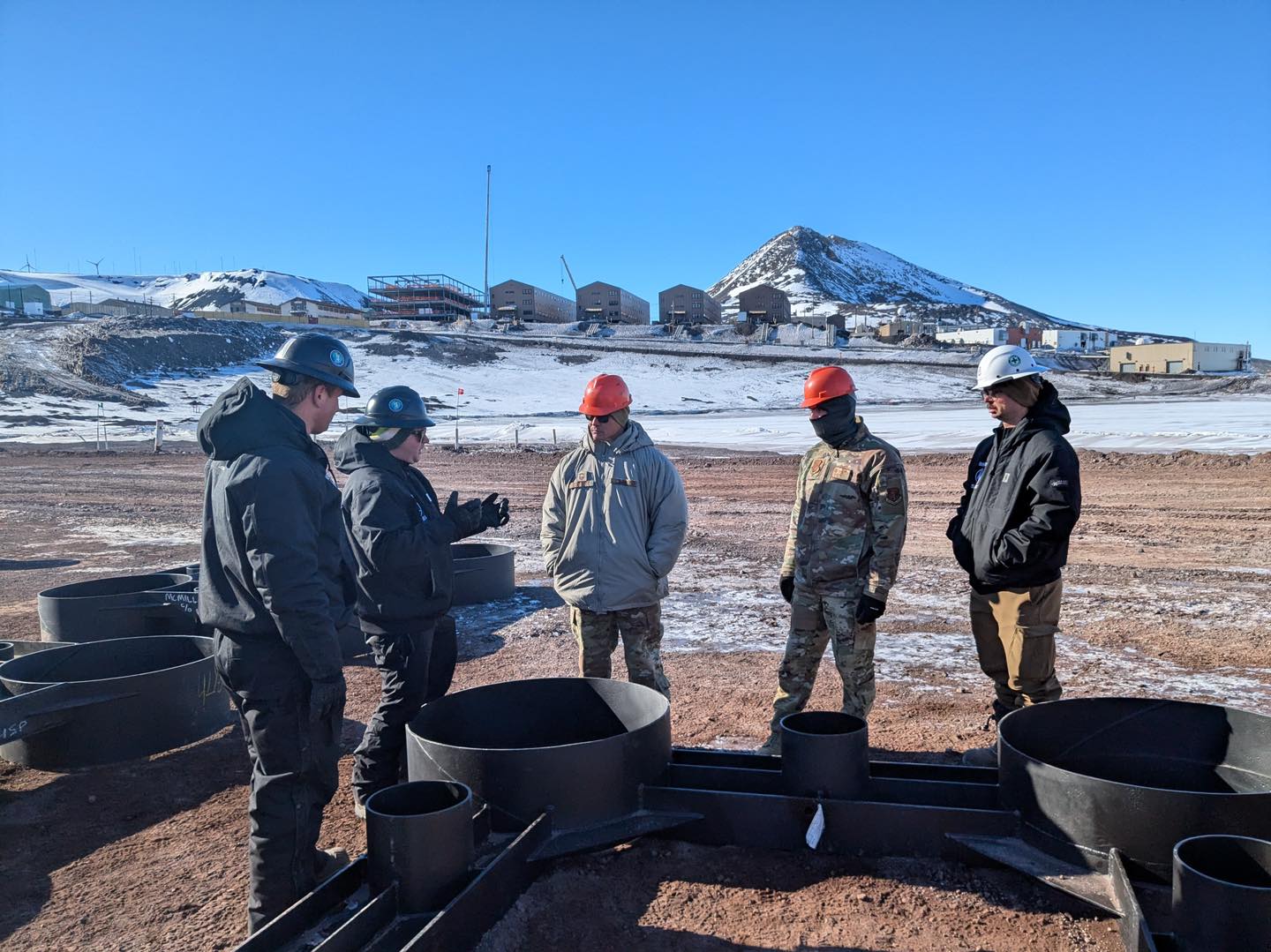
Below...a significant part of the project at McMurdo last summer...preparing to drill holes for piles that will moor the barge pier.
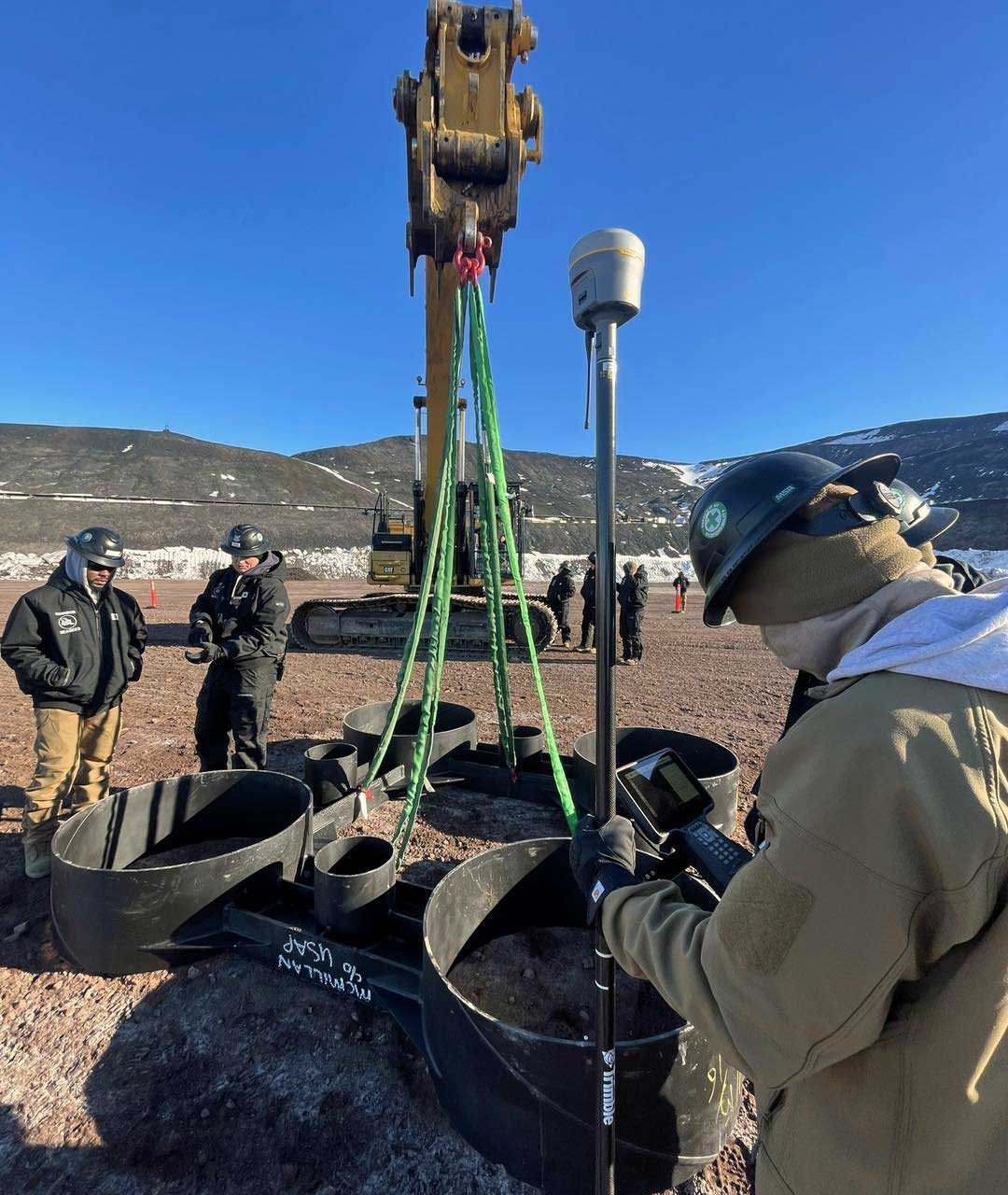 Positioning one of the templates used for locating the pile
 Drilling holes for the mooring anchors.
On 15 May 2025 DVIDS issued a press release about the McMurdo barge pier work done by a detachment of Seabees from NMCB)\-3 based in Port Hueneme, CA. The photos immediately attached to this report show the Seabees doing snow clearance at Williams Field. The drilling equipment was procured and the work was monitored by Antarctica New Zealand...some of the work was done by a Navy Seabee detachment from NMCB-3 (more info and photos about the Seabee deployment to Antarctica)--they also spent time working at Pole.
 An early mooring diagram for the barge pier. These drawings also depict how the various vessels will be moored.
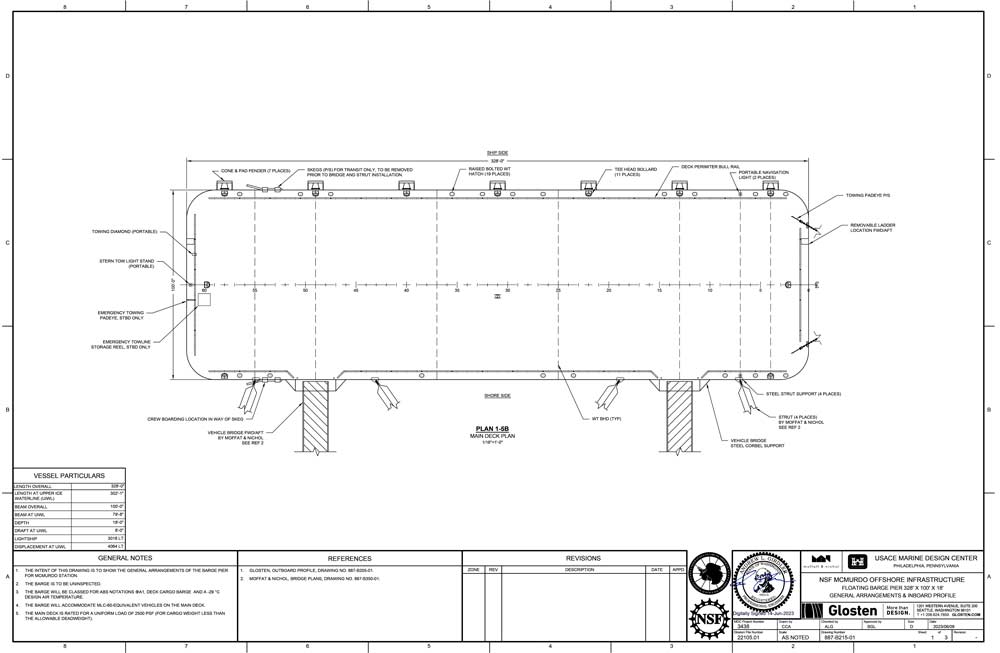 A plan view of the barge pier. Instead of the mooring depicted at left, the pier will be anchored by 4 struts anchored on shore...the piles for which were being drilled by the Seabees as seen in the above photos, with each concrete mooring point anchored by 4 piles. I'm thinking 12 piles...the two struts midships on the barge pier will be anchored to the same mooring point. (more info and barge pier drawings).
  One set of the mooring strut anchor piles. I'm not sure when these were installed or by whom.
 One of the precast mooring anchor pile caps. The mooring struts will be bolted to these.
But later I learned that some of the piles needed to be redone because they'd "tilted." Could not figure out how that might have happened, but in October 2025 the team returned with the Liebherr LR1160 that Antarctica New Zealand (ANZ) had brought down the previous season and was used to place the piles, here's a great YouTube video featuring the pile extraction. No ice/water in the piles...early in the video they describe having to melt them out to make extraction possible.
 A video by Gunderson Marine president Dee Burch describing the barge pier, from the Gunderson Marine website.
 Fabricating the barge pier nameplate: Discovery Pier!
The DVIDS photo above was taken by LTJG Karena Garcia (more DVIDS photos here), and here is their privacy/publicity/usage information page. The other images are credited to NSF, mostly from the future.usap page linked above.