|
Press Release 08-006
NSF Dedicates New South Pole Station

Elevated structure is the third U.S. station at the Pole since 1956, and an engineering marvel
January 15, 2008
To obtain b-roll, contact Dena Headlee at dheadlee@nsf.gov.
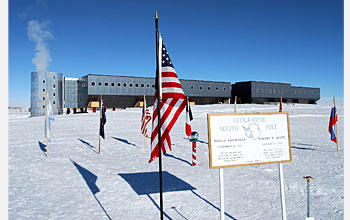
The United States has dedicated a new scientific
station at the geographic South Pole--the third since 1957--officially
ushering in a new support system for sophisticated large-scale
experiments in disciplines ranging from astrophysics to environmental
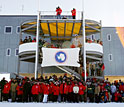
chemistry and seismology. The dedication of the new Amundsen-Scott
South Pole Station, which took place on Sat., Jan. 12, local time (U.S.
stations in Antarctica keep New Zealand time), also reasserts the
National Science Foundation's (NSF) vital role in managing the U.S.
Antarctic Program in order to meet the needs of the U.S. research
community as well as those of other federal agencies. NSF manages the
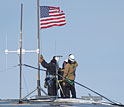
U.S. Antarctic Program. Arden L. Bement Jr., NSF director, spoke
to an assembled group of dignitaries as the American flag was raised
over the new elevated station. Just hours before, the stars and stripes
had been struck for the last time over the iconic domed station adjacent
to the new building, which had served as the U.S. scientific outpost at
the South Pole since the mid-1970's. In attendance were heads of
federal agencies with a scientific presence at the Pole and others who
played key roles in the design and completion of the project. "Our
purpose is to dedicate a facility that will help us push back the
boundaries of the unknown--a quest that has continued year-round at this
site for over 50 years," Bement said. "And to pay our respects to those
who helped transform this mysterious and forbidding continent into a
globally recognized place of wonder, transformation and knowledge." Bement
also remarked on the contributions to polar exploration of New
Zealander Sir Edmund Hillary, who died at the age of 88 just hours
before the ceremony. "It is fitting that we pause for a moment to
remember the accomplishments of Sir Edmund Hillary, who stood near this
very spot in January 1958, the first person to do so since Robert Falcon
Scott in 1912," he said. "I was honored to meet him at the 50th anniversary
of the building of New Zealand's Scott Base in 2007, an accomplishment
for which he was responsible. I cannot help but believe that he is here
with us in spirit today as we usher in this new phase of scientific
exploration of the continent which he so loved." Bement was joined
at the ceremony by two former NSF directors: Neal Lane, senior fellow
in science and technology policy at Rice University's James A. Baker III
Institute for Public Policy, and Rita Colwell, chairman of Canon U.S.
Life Sciences, Inc. and distinguished professor both at the University
of Maryland at College Park and at Johns Hopkins University's Bloomberg
School of Public Health. NSF is responsible for the operation of the new station as well as the reconstruction and associated environmental upgrades. Also in attendance at the ceremony were: - Vice Adm. Conrad C. Lautenbacher, Jr., undersecretary of commerce for oceans and atmosphere at the National Oceanic and Atmospheric Administration (NOAA)
- Jay M. Cohen, undersecretary for science and technology at the Department of Homeland Security
- Alexander Karsner, assistant secretary for energy and renewable energy at the Department of Energy
- Paula J. Dobriansky, undersecretary for democracy and global affairs at the State Department
Rep. Rodney P. Frelinghuysen, the ranking member of the House Appropriations Subcommittee on Commerce, Justice, Science, and Related Agencies Patricia J. Walker, deputy assistant secretary of defense for reserve affairs, materiel and facilities - Kathy Sullivan, vice chair of the National Science Board
Maj. Gen. Robert A. Knauff, chief of staff and commander N.Y. Air National Guard Col. Ron Smith, U.S. Air Force, commander of Operation Deep Freeze, the military support for the U.S. Antarctic Program Karl A. Erb, director of NSF's Office of Polar Programs Norman Augustine, chairman, and Susan Solomon, NOAA scientist and member of the blue-ribbon panel whose report led to the rebuilding of the station
Erb
noted that the dedication occurred slightly more than 50 years after
men spent the first winter at the Pole in 1957, during the International
Geophysical Year (IGY). That first group was an 18-member team of U.S
Navy personnel and civilian scientists. The dedication, Erb
added, coming as it does at the height of the International Polar Year
(IPY), a concerted scientific field campaign supported by more than 60
nations worldwide which shares many of the IGY goals, has a particular
resonance. Erb also noted that the
new station not only is dramatically more technologically and
architecturally sophisticated than the 1975 station or its predecessor,
but is also almost immeasurably different from the first habitation ever
erected at the Pole: a pyramidal tent left as proof of his
accomplishment by the first man to reach the site, Norwegian Roald
Amundsen, and for Briton Scott, whose party reached the Pole a month
later. The station is named for the two explorers. The
replacement of the South Pole station was given critical support by the
external panel chaired by Augustine, who, in a key 1997 report, argued
that the existing facilities at the South Pole were both outmoded and
potentially unsafe. The report noted that "Antarctica today is a
continent generally characterized by peaceful, environmentally friendly,
human activity. High among the reasons for this situation is the role
played by the U.S. over many years in helping create a system of
treaties and international agreements governing the nature of human
conduct on the continent. The presence of the U.S. in Antarctica is a
key element of the continued stability of the region." To
maintain that stability the panel recommended that the "U.S., as a
matter of national policy, should maintain a continued year-round
presence in Antarctica, including at the South Pole." But
the panel also found that, at the time, "various critical safety and
health deficiencies exist at U.S. facilities in Antarctica, particularly
at South Pole Station," and recommended environmental upgrades and
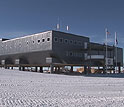
reconstruction. The elevated station is the most imposing
structure ever built at the Pole and the 12-year reconstruction required
extraordinary effort to complete. It required 925 flights by
ski-equipped LC-130 aircraft flown by the N.Y. Air National Guard. At
26,000 pounds of cargo per flight, a total of 24 million pounds of cargo
were transported. In November of 2007, Popular Science magazine named the new station as one of its "Best of What's New" innovations of the year.
-NSF-

Media Contacts
Peter West, NSF (703) 292-7761 pwest@nsf.gov
Related Websites
NSF Special Report: U.S. South Pole Station: /amundsen-scott-south-pole-station
The U.S. government International Polar Year (IPY) portal: http://www.ipy.gov (archive)
News release: Landmark Completion of South Pole Telescope to Help Scientists
Learn What the Universe Is Made of and How it Got Here: /news_summ.jsp?cntn_id=108413 (archive)
Popular Science Magazine's "Best of What's" New Web site: popsci.com archive
United States Antarctic Program: https://www.usap.gov
The National Science Foundation (NSF) is an independent federal
agency that supports fundamental research and education across all
fields of science and engineering. In fiscal year (FY) 2012, its budget
is $7.0 billion. NSF funds reach all 50 states through grants to nearly
2,000 colleges, universities and other institutions. Each year, NSF
receives over 50,000 competitive requests for funding, and makes about
11,000 new funding awards. NSF also awards nearly $420 million in
professional and service contracts yearly.
 Get News Updates by Email Get News Updates by Email
Useful NSF Web Sites:
NSF Home Page: https://www.nsf.gov
NSF News: https://www.nsf.gov/news/
For the News Media: https://www.nsf.gov/news/newsroom.jsp
Science and Engineering Statistics: http://www.nsf.gov/statistics/
Awards Searches: https://www.nsf.gov/awardsearch/
|